- August 17, 2026
- admin
- 0
Anxiety Tips:
6 Proven Ways to Calm Your Mind and Body Fast
Living with persistent worry, a racing heartbeat, or an overactive mind can feel exhausting. Whether you are dealing with everyday work stress or sudden bouts of panic, finding practical, science-backed anxiety tips is essential to regaining control over your daily life.
Anxiety is not just “in your head”—it is a full-body physiological response designed to protect you from perceived danger. When this internal alarm system triggers at the wrong times, you need actionable anxiety tips that work quickly to downshift your nervous system.
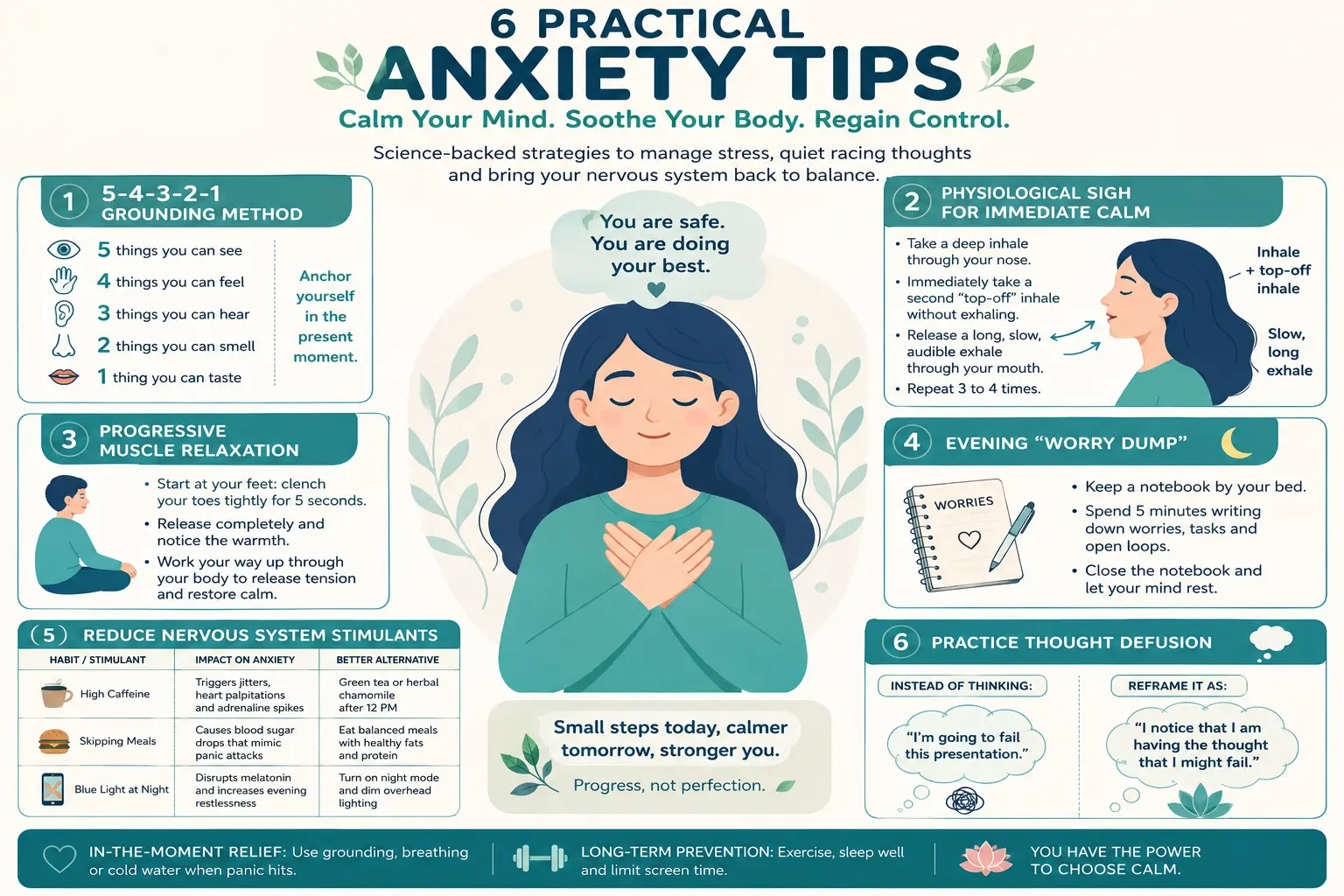
Here are 6 proven anxiety tips you can use immediately to manage stress, release physical tension, and quiet racing thoughts.
Why Physical Interventions Work Best for Fast Relief
When you experience an anxiety spike, your sympathetic nervous system floods your bloodstream with cortisol and adrenaline. During these moments, simply telling yourself to “stop worrying” rarely helps because the rational parts of your brain are temporarily overwhelmed by survival instincts.
The most effective anxiety tips focus on physical, bottom-up techniques. By calming your heart rate and easing muscular tension first, you send direct biological signals to your brain that you are safe. Once your body settles, your mental clarity naturally follows.
6 Practical Anxiety Tips to Try Today
1. Master the 5-4-3-2-1 Grounding Method
When panic pulls your attention into catastrophic future scenarios, grounding techniques anchor you back to the present moment.
- 5 things you can see: Look around and notice small visual details (a picture frame, the texture of a desk, light on the wall).
- 4 things you can physically feel: Notice your feet flat on the floor, the fabric of your shirt, or the temperature of the air.
- 3 things you can hear: Listen for ambient sounds, like a passing car, distant chatter, or a ticking clock.
- 2 things you can smell: Focus on the scent of coffee, fresh air, or your hand lotion.
- 1 thing you can taste: Take a sip of water or notice the lingering taste of mint.
This exercise is one of the most reliable anxiety tips for breaking a cycle of racing, runaway thoughts.
2. Practice the Physiological Sigh for Immediate Calm
Developed and studied by neuroscientists, the physiological sigh is the fastest way to reduce autonomic arousal in real time.
- Take a deep inhale through your nose.
- Immediately take a second, sharp “top-off” inhale without exhaling.
- Release a long, slow, audible exhale through your mouth.
- Repeat this pattern 3 to 4 times.
Among modern anxiety tips, this specific breathing method stands out because the double inhale re-inflates collapsed alveoli in your lungs, triggering an immediate drop in your resting heart rate.
3. Implement Progressive Muscle Relaxation (PMR)
Anxiety often causes unconscious tension in your jaw, neck, and shoulders. Progressive Muscle Relaxation teaches your body the stark contrast between tension and release:
- Start at your feet: clench your toes tightly for 5 seconds.
- Release completely and notice the warm sensation of relaxation.
- Work your way up through your calves, thighs, abdomen, chest, hands, shoulders, and face.
Using structured anxiety tips like PMR prevents prolonged physical stiffness from fueling further mental stress.
4. Create an Evening “Worry Dump”
Nighttime anxiety often spikes because your brain tries to rehearse unfinished tasks and unresolved worries in the dark.
- Keep a designated notebook on your nightstand.
- Spend 5 minutes before bed writing down every open loop, task, and anxious thought on paper.
- Close the notebook to signal to your brain that these thoughts are safely stored until tomorrow.
Writing things down clears working mental memory, making this one of the most practical anxiety tips for better sleep.
5. Cut Down on Hidden Nervous System Stimulants
What you consume directly influences how easily your body enters an anxious state:
Habit / Stimulant | Impact on Anxiety | Better Alternative |
High Caffeine | Triggers jitters, heart palpitations, and adrenaline spikes | Switch to green tea or herbal chamomile after 12 PM |
Skipping Meals | Causes blood sugar drops that mimic panic attacks | Eat balanced meals with healthy fats and protein |
Blue Light at Night | Disrupts melatonin and increases evening restlessness | Turn on night mode and dim overhead lighting |
Applying lifestyle-based anxiety tips helps keep your baseline nervous system stable throughout the day.
6. Practice “Thought Defusion”
When an anxious thought arrives, avoid arguing with it or trying to suppress it forcefully. Instead, practice thought defusion by labeling it objectively:
- Instead of thinking: “I’m going to fail this presentation.”
- Reframe it as: “I notice that I am having the thought that I might fail.”
This small cognitive shift creates space between you and your anxiety, allowing you to observe your worries without being controlled by them.
Daily Habits vs. In-the-Moment Strategies
Understanding which anxiety tips to use depends on your situation:
- In-the-Moment Relief: Use the physiological sigh, cold water on your face, or the 5-4-3-2-1 technique when panic hits suddenly.
- Long-Term Prevention: Prioritize regular aerobic exercise, consistent sleep schedules, and reduced screen time to prevent chronic nervous system overload.
Combining both approaches gives you a comprehensive toolkit to handle stress proactively.
Take Back Control of Your Calm
Managing stress is an ongoing practice rather than an overnight fix. You do not need to master every single strategy at once; start by testing one or two of these anxiety tips the next time you feel overwhelmed. With consistent practice, you can retrain your nervous system to respond to pressure with resilience and calm.